

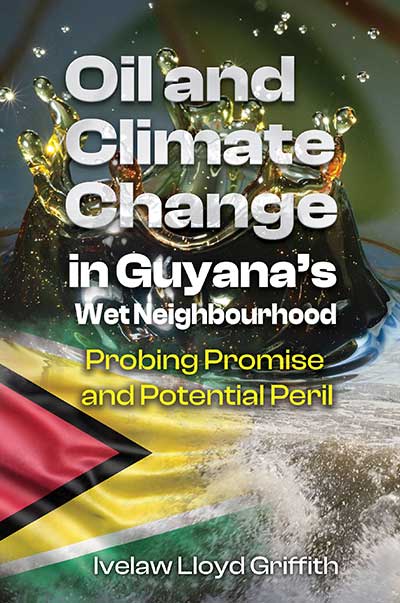
Oil And Climate Change In Guyana’s Wet Neighborhood
$38.50
Probing Promise And Potential Peril
By: Ivelaw Lloyd Griffith
Description
Guyana resides in an oil-endowed neighbourhood, along with Venezuela, Brazil, Colombia, and Trinidad and Tobago as major oil and gas producers and Suriname rising in the petro production ranks. However, South America’s sole Anglophone republic is also located in a wet neighbourhood, where climate change has begun to impact society and can diminish some of the oil gains. This dual reality requires understanding the vicissitudes of the promise of oil and the potential peril of climate change. Oil and Climate Change in Guyana’s Wet Neighbourhood undertakes this task.
Griffith examines the dynamics of the country’s oil pursuits in the context of its political environment and provides an assessment of its physical and social geography and its environmental security vulnerability that has been accentuated by climate change factors. He traces the historical background and evolution of Venezuela’s claim to the Essequibo region, going to great lengths to explain the geoeconomic and geopolitical implications for the country’s petro power pursuits.
Included in the book are numerous charts, graphs, and tables that bring together, in one place, facts and statistics about Guyana’s oil, gas, and climate change realities, that will be of immense value to a wide range of stakeholders from researchers, scholars and journalists, to persons wishing to exploit the business and economic opportunities that abound in the country.
Additional information
| Weight | 2 lbs |
|---|---|
| Dimensions | 9 × 6 in |
| Binding | Paperback |
Contents
List of Figures
List of Maps
List of Boxes
List of Tables
Preface and Acknowledgments
Acronyms and Abbreviations
Introduction: Contemplating Promise and Peril
Introduction
The Paradox, The Big Leagues
Promise and Potential Peril in Global Context
More Heat, Less Snow, Big Impact
Book Aims and Approach
Conclusion
Contextual Conditions: Understanding the Political Environment
Introduction
The Governmental Arena
The Non-Governmental Arena
Conclusion
Treasure Chest in the Basement
Introduction
The Basement and its Contents
Contentious Considerations: Contracts and Oil Spills
Conclusion
The Essequibo Neighbourhood
Introduction
Historical Landscape
The Essequibo Neighbourhood
On the Global Stage
Venezuela’s Intimidation Playbook
Conclusion
The Essequibo Neighbourhood: Geopolitical Implications
Introduction
Intermestic Factors and Dangerous December Days
Small State Leader, Big Time Interlocutor
Conclusion
The Wet Neighbourhood: Dynamics of Environment and Climate Change
Introduction
Guyana’s Wet Neighbourhood
Environmental Security
Conclusion
Conclusion: Pondering the Future of Promise and Peril
Introduction
Low-Carbon Development Strategy
Pondering the Paradox
Conclusion
Twenty Oil and Climate Change Fun Factoids
References
Reviews
This book is essential reading for anyone, especially Guyanese, interested in understanding the precarious relationship between the promise of oil and gas and the perils of climate change in ‘wet Guyana.’ It is written with authority and understanding by a leading scholar who hails from Guyana. Historians will use it as a foundation study when coming to a judgment on Guyana’s gamble to exploit oil and gas at a time when the future of the planet is gravely imperiled, particularly Guyana, lying as it does below sea-level in its coastal areas.
Dr Bertrand Ramcharan, Eminent Caribbean International Jurist, Academy of the Caribbean Court of Justice and Seventh Chancellor of the University of Guyana.
A must-read for anyone seeking to understand Guyana’s dramatic rise as one of the fastest-growing economies and the world’s third-largest per capita oil producer. This book explores the complex intersection of oil development and climate change in Guyana, a small South American nation now emerging as a global petro-power. The author frames Guyana’s situation as a paradox: while the country rapidly climbs the economic ladder through massive offshore oil discoveries in the Stabroek Block, it simultaneously faces the existential threat of climate change, particularly due to its low-lying, flood-prone geography.
In Oil and Climate Change in Guyana’s Wet Neighbourhood, the author highlights the dynamic interplay between Guyana’s physical and social geography and its ‘Wet Neighbourhood’ vulnerabilities – risks such as heavy rainfall, coastal flooding, sea-level rise, and storm surges. Through comprehensive analysis, the book outlines how Guyana has become a key player in the global energy market, with oil production projected to reach 1.3 million barrels per day by 2030. This economic boom is accompanied by bold national initiatives like the Low-Carbon Development Strategy (LCDS), Silica City, and far-reaching cash grant programs.
Yet, the author cautions that the promise of oil wealth also brings peril if climate and environmental risks are not effectively managed. He examines the political, legal, and civic frameworks shaping oil governance, from environmental lawsuits to regional instability –especially Venezuela’s intimidation tactics. With detailed figures, expert commentary, and sharp insights, Griffith issues a scholarly and policy-relevant call to action for Guyana and similarly positioned emerging petro-states. This is a compelling exploration of how nations can navigate the tightrope between resource-driven growth and sustainable resilience.
Dr Norman Munroe, Professor of Mechanical and Materials Engineering, Florida International University, and Workshop Facilitator on Climate Change and Greenhouse Gas Accounting for the Commonwealth Secretariat, UK.
Professor Ivelaw Lloyd Griffith has added to his already impressive scholarly output with this groundbreaking, comprehensive study of modern-day Guyana and the ‘Promise and Peril’ of the astonishing oil-driven transformation currently under way. Oil and Climate Change in Guyana’s Wet Neighbourhood presents a balanced analysis of the promise of oil and the potential peril that climate change portends. The author accordingly explores the paradox of the Guyana government’s determination to make the most of its oil and gas windfall whilst remaining committed to combatting climate change. At the same time, he drills down, drawing on a number of sources, both pro and anti-oil, as well as supportive and critical of the government’s policies, to focus on: the political environment; details about oil production; the controversial production sharing agreement with the consortium responsible for all of Guyana’s oil production to date; the risk of oil spills; the physical and social geography of the country; the country’s environmental security in the context of global warming and rising sea levels; and Venezuela’s threat to the Essequibo region and Guyana’s maritime area, and the geopolitical dynamics involved. It is no exaggeration to say that this is a first-of-its-kind study of a historical moment in Guyana’s growth as a young, small developing state and now a rapidly evolving petrostate.
Dr Riyad Insanally, former ambassador of Guyana
to the United States and the OAS
There is an enormous gap of scholarly contributions on complex thematic subjects relating to Guyana. In filling this gap, Professor Griffith masterfully unpacks Guyana’s decade-long journey by assessing the paradox of petro-power and environmental vulnerability. The book examines Guyana’s staggering economic growth trajectory from oil production alongside the urgent need to address climate change, adaptation and security. He emphasises that doing so necessitates ‘intentionality’ and he offers insights into geopolitical dynamics – chiefly the Guyana/Venezuela border issue in which Venezuela is seeking to invalidate the 1899 Arbitral Award. Accordingly, Professor Griffith’s work is an indispensable, quintessential guide for policymakers and environmental advocates and others navigating economic development whilst balancing environmental preservation.
Joel Bhagwandin, Chief Financial Advisor/Director,
SphereX Professional Services, Guyana
If you want to separate the chaff from the grain surrounding the myriad issues enjoined by public criticism, support, opinions, and controversies apropos of Guyana’s most consequential oil and gas industry, this is the book to read.
With his previous ten highly-acclaimed books, the author has undoubtedly established himself amongst the Caribbean’s most distinguished scholars and has been ahead of the times covering the wide array of challenges now facing Guyana with the advent of oil and gas, including national security, environment, economy, democracy, sovereignty, and diaspora engagement. Backed up by a full suite of references to support its analysis, this book is a masterpiece of the entwining of these national challenges. The author comprehendingly tackles the world’s foremost concern of climate change attributable to fossil fuels.
Professor Griffith brings to the fore the quagmire confronting Guyana that, while by force of circumstance, it has to rely upon its newly found oil bonanza to transform the nation from poverty to vast wealth, at the same time has to contend with the reality of going against the world’s trending transition away from fossil fuels. The book also addresses Guyana’s high vulnerability and risks to its own devastation from climate change.
Considering the unfortunate backdrop of the country’s chasmic political divisiveness that, for the most part, has been driving biased public narratives, this book removes such political blinders by presenting the first nonpartisan, balanced and comprehensive analyses of the interconnected national issues and challenges facing the nation that have been intensified by the advent of this unplanned for gift of oil.
Dr Vincent Adams, former Executive Director,
Environmental Protection Agency, Guyana
From the inside looking out into the world of cutting edge technology, economic growth and reliable infrastructure, the people of Guyana eagerly applaud the windfall of billions of petrodollars and its promise of parity with Middle Eastern growth and progress. From the outside looking into Guyana’s mighty forests and vulnerable coastline, people around the world who stop to take notice are anxious about the effects of climate change on South America’s only English-speaking country. In this book, Professor Ivelaw Griffith reveals the economic, political, contextual, operational and sometimes philosophical perspective from both sides. Each chapter is supported by historical facts, insightful analysis and relevant references to bring the reader a balanced and comprehensive view of the conundrum from without and within Guyana. As history is being made in Guyana, this book presents a conversational review of what has happened so far and future possibilities. It is a must read!
Dr Lorraine Sobers, University of the West Indies (St Augustine)
Petroleum Engineer
Professor Ivelaw Griffith’s new book is a major achievement. It provides a sweeping survey of the paradox of Guyana’s development that pivots simultaneously on wealth from oil and hopes for sustaining its commitment to a low-carbon development strategy. Its analysis is ambitious, with writing that is erudite. It is bold in scope, sound in judgement, and rich in provocations. In short, it is essential reading!
Professor Edward Greene, Chancellor, University of Guyana
If you want to separate the chaff from the grain surrounding the myriad issues enjoined by public criticism, support, opinions, and controversies apropos of Guyana’s most consequential oil and gas industry, this is the book to read. The author brings to the fore the quagmire confronting Guyana that, while by force of circumstance, it has to rely upon its newly found oil bonanza to transform the nation from poverty to vast wealth, at the same time it has to contend with the reality of going against the world’s trending transition away from fossil fuels. The book also addresses Guyana’s high vulnerability and risks to its own devastation from climate change.
Dr Vincent Adams, former Executive Director, Environmental Protection Agency, Guyana
Professor Griffith masterfully unpacks Guyana’s decade-long journey by assessing the paradox of petro-power and environmental vulnerability. The book examines Guyana’s staggering economic growth trajectory from oil production alongside the urgent need to address climate change, adaptation and security. He emphasises that doing so necessitates ‘intentionality’ and he offers insights into geopolitical dynamics – chiefly the Guyana/Venezuela border issue in which Venezuela is seeking to invalidate the 1899 Arbitral Award. Accordingly, Professor Griffith’s work is an indispensable, quintessential guide for policymakers and environmental advocates and others navigating economic development whilst balancing environmental preservation.
Joel Bhagwandin, Chief Financial Advisor/Director, SphereX Professional Services, Guyana
Professor Ivelaw Griffith’s new book is a major achievement. It provides a sweeping survey of the paradox of Guyana’s development that pivots simultaneously on wealth from oil and hopes for sustaining its commitment to a low-carbon development strategy. Its analysis is ambitious, with writing that is erudite. It is bold in scope, sound in judgement, and rich in provocations. In short, it’s essential reading!
Professor Edward Greene, Chancellor, University of Guyana


