

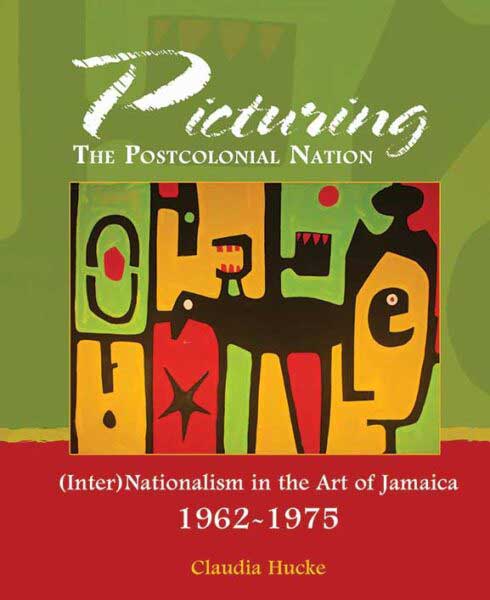
In post-independent Jamaica, a period marked by significant social, political and cultural shifts, art played a vital role in establishing an identity for a hybrid nation at the dawn of its self-discovery. Picturing the Postcolonial Nation: (Inter) Nationalism in the Art of Jamaica 1962−1975 examines the relationship between art and nation-building, highlighting the varied ways art was used to not only define Jamaica but to promote and brand a Jamaica that was as innovative, rich and changing as art itself.
Claudia Hucke’s detailed tour of Jamaican art during this transformative period shows the challenges faced in branding the new nation. Creative artistic expression and individuality were criticised for misrepresenting the nation at home and abroad but especially during travelling exhibitions that were supposed to affirm Jamaica as a cultural exporter of folk art. However, through the Contemporary Artists’ Association (CJAA) founded by artists Eugene Hyde, Karl Parboosingh and Barrington Watson, those charged with branding an image of Jamaica began to craft one worthy of the hybrid nation through a synthesis of the colonial with the postcolonial, folk with modern, and the international with national art.
Contents
List and Sources of Illustrations (150)
Acknowledgements
Introduction
1.’A Nation Without Art is not a Nation?’: Art and Nation-Building in Jamaica Pre-Independence
- Making of History and Search for the Authentic: Jamaican Cultural Politics Post-Independence
- In and Outside the Nation: The Contemporary Jamaican Artists’ Association
- ‘Emerging from the Palm Groves and Sugar Cane Fields’: Jamaican Visual Art Exhibitions Abroad
Conclusion
Appendices
Notes
Bibliography
Index
About The Author
Claudia Hucke is a Senior Lecturer in Art History at the Edna Manley College of the Visual and Performing Arts, Kingston, Jamaica. She holds a PhD in Art History from the University of Hamburg, Germany and is an independent curator whose work includes Jazz and Tings – Selection from Karl Parboosingh’s Sketchbooks at the Bolivar Gallery and the Barrington Watson retrospective at the National Gallery of Jamaica.