

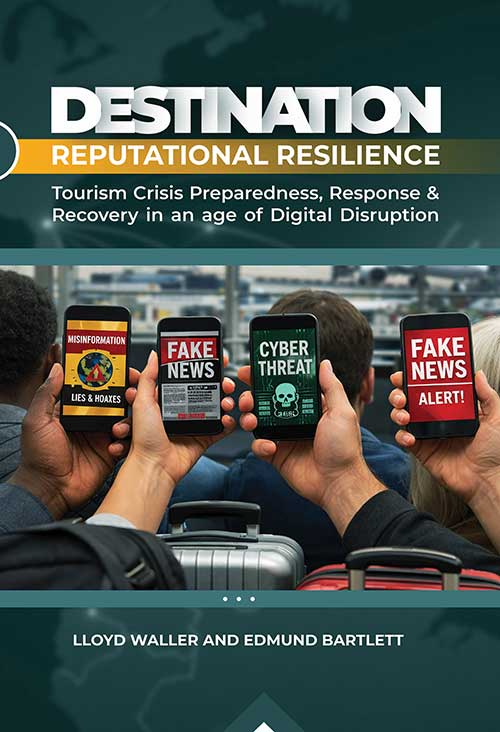

In today’s hyper-connected world, destinations are no longer disrupted only by hurricanes, health crises, or economic shocks. They are increasingly destabilised by cyber threats, misinformation, disinformation, fake news, deepfakes, privacy breaches, and digital system failures, forces capable of collapsing demand even when physical infrastructure remains fully intact. A destination may be operationally open, yet reputationally closed. Tourism has always been exposed to risk. What has changed is the nature, speed, and reach of that risk. Disruptions now travel through digital networks before emergency teams are deployed, shaping perception long before facts are verified. Belief moves faster than evidence, and narrative damage often precedes physical impact. What must also change is how the tourism industry responds. Traditional tools, branding, marketing, and reactive crisis communication, are no longer sufficient in an environment defined by algorithmic amplification and information disorder. This book addresses that gap. It is about equipping destinations with the systems, capabilities, and frameworks required to anticipate disruption, defend credibility under pressure, and recover trust with proof in the age of digital disruption.
Written by two of the world’s leading authorities on tourism resilience, whose work has shaped global thinking, policy, and institutional practice in the field, Destination Reputational Resilience represents a deliberate and focused exploration of one of the most critical and under-examined dimensions of modern tourism disruption: reputation as a system of trust, credibility, and proof. Drawing on global case studies from Small Island Developing States, emerging economies, and advanced tourism markets, the authors demonstrate how reputational disruption amplifies crises, delays recovery, redirects demand across borders, and undermines long-term competitiveness. They show why traditional approaches, nation branding, crisis communication, and destination marketing, are no longer sufficient on their own in an era shaped by algorithmic amplification and digital manipulation.
The book introduces a Destination Reputational Resilience framework designed specifically for the travel and tourism sector. Integrating insights from crisis management, cybersecurity, risk intelligence, behavioural science, governance, and strategic communication, it offers a practical operating system for destinations to prepare for disruption, manage crises under pressure, and recover faster with credibility and proof. Central to this framework is the responsible use of Generative Artificial Intelligence (GenAI) – not only as a source of emerging risk, but as a powerful tool for early warning, verification coordinated response, and trust restoration. This volume does not attempt to address every challenge facing global tourism. Instead, it focuses on a defining moment: how destinations can safeguard trust in an age where belief travels faster than fact. Written for ministers, destination management organizations, tourism executives, regulators, researchers, and students, it combines thought leadership with actionable tools that can be applied across diverse tourism contexts
As global tourism navigates accelerating digital, geopolitical, and environmental disruption, this book makes a clear argument: the destinations that will endure, resilient destinations, are those that can remain credible while disrupted, and recover faster than the narrative damage.
CONTENTS
Foreword
Shaikha Al Nuwais
Secretary-General, UN Tourism
The World We Live In
Cybersecurity, Cyber Terrorism, and Other Cyber Threats in Tourism Infrastructure
How Fake News, Disinformation, and Misinformation Disrupt Travel and Tourism
Destination Reputational Resilience
Building a Destination Reputational Resilience Framework – Diagnosing Exposure and Mapping the Destination Trust System
Phase 2 – Prepare (Building the Internal Operating System for Resilience)
Running the System through Disruption and Recovery
Running the System Through Disruption and Recovery: The Final Two Resilience Phases and the Feedback Loop
References